
The sea holds its breath when the shadow passes beneath. It is not a shadow of cloud or reef, but a living darkness, a hunger given ancient form. In the sun-dappled waters of Sea of Thieves, few sights quicken a pirate's pulse like the sudden breach of a colossal dorsal fin, a scythe cutting the horizon, heralded by the frantic crescendo of strings. This is the Megalodon, the alpha predator of the digital waves, a leviathan whose fictional ferocity is but an echo of a real-world ghost that once ruled the Neogene oceans. To the corsairs of 2026, it is a beast of wood-splintering charge and thunderous cannonade. To the paleontologist, it is Otodus megalodon, a name whispered through fossilized teeth, a phantom whose true size and nature are still emerging from the deep time of Earth's history.
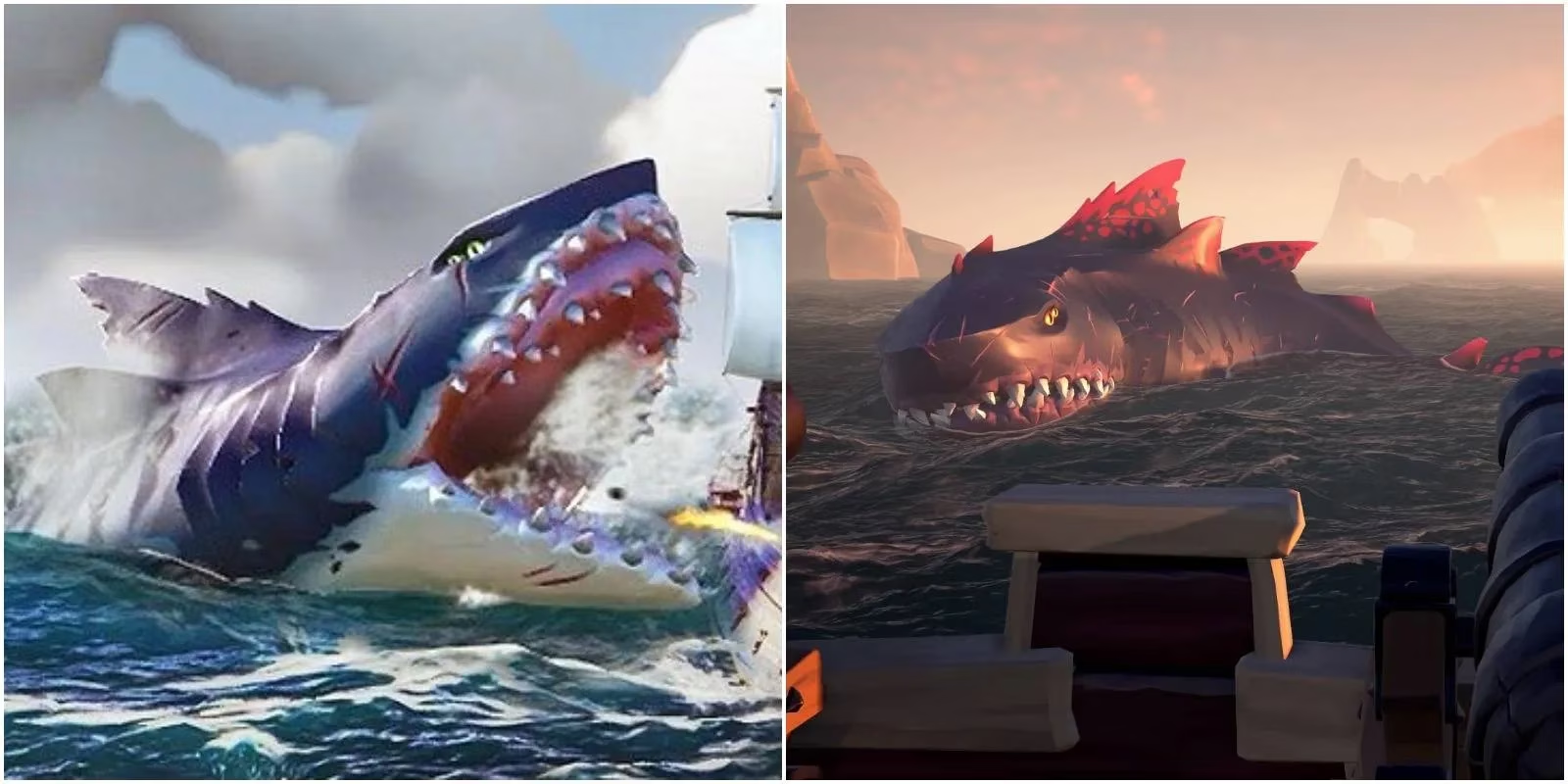
🦈 The Chromatic Phantoms of the Sea
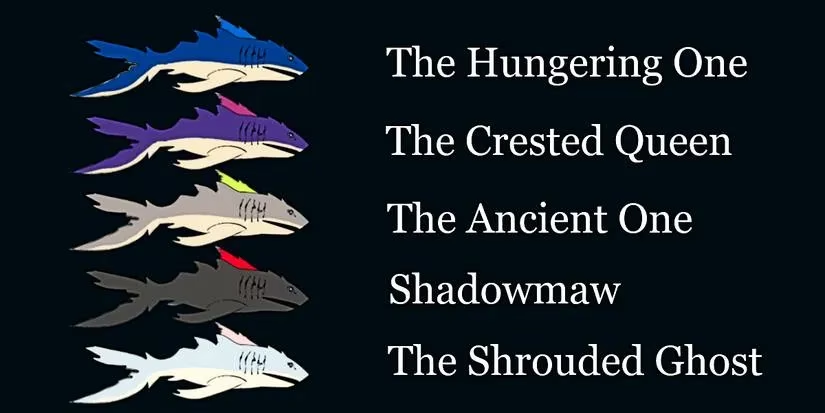
In the world of Sea of Thieves, the Megalodon is not a singular terror, but a spectrum of it. Five distinct types, distinguished by the hues of their spectral scales, patrol the shipping lanes. Yet, here's the thing—each beast, regardless of its color, carries a unique personality. Just like real sharks, some are all bluster and charge, while others possess a more calculating, relentless aggression. You never quite know what you're gonna get until that iconic music swells and the hunt begins. They are hostile by nature, these chromatic phantoms, bound to their aquatic territories. A ship can flee, sailing beyond the invisible borders of the beast's domain, and the pursuit will cease. But for those with plunder in their hearts and cannonballs to spare, the confrontation is a rite of passage.
⚔️ The Dance of Cannons and Jaws
The combat dance with a Meg is a brutal, predictable, yet heart-stopping ballet. The beast knows its strength: a devastating charge culminating in a bite that can punch 1 to 5 holes in a ship's hull in one go. The size of the vessel—be it the nimble Sloop, the balanced Brigantine, or the mighty Galleon—dictates the wound. But a clever crew can parry this blow. Fire enough cannon shots into the monster's gaping maw as it charges, and the attack is thwarted. The cost of this defense?
| Ship Type | Cannonballs to Stop a Charge |
|---|---|
| Sloop | 2 shots |
| Brigantine | 4 shots |
| Galleon | 6 shots |
Victory, however, requires more than defense. Sending a Meg to the depths demands a sustained bombardment. Again, the ship's size changes the calculus:
-
Sloop: 12-15 direct hits.
-
Brigantine: 15-18 direct hits.
-
Galleon: A whopping 30-32 direct hits.
But direct combat isn't the only path. Sometimes, the smartest pirate lets others do the fighting. The skeletal cannoners stationed on lonely isles, often a nuisance, can become unlikely allies. Luring a Meg into their range can spark a chaotic battle. The mindless skeleton will pepper the shark with shots, and the Meg, frustrated and unable to reach its bony tormentor, will swim in doomed circles until the cannon fire whittles it down. It's a slow, almost poetic end—the ancient predator bested by an even more ancient, undead grudge.
🦴 The Ghost in the Stone
The digital beast is thrilling, but the real creature, Otodus megalodon, is a story written in fragments. Its cartilaginous skeleton vanished eons ago, leaving behind only its colossal, serrated teeth and jaw fragments as testaments to its existence—terrifying postcards from the Neogene period (23 to 2.6 million years ago). In 2026, the debate on its true size continues, with estimates placing it, on average, between 50 to 60 feet long. New discoveries constantly refine our understanding, pulling the veil back on an ocean very different from our own.
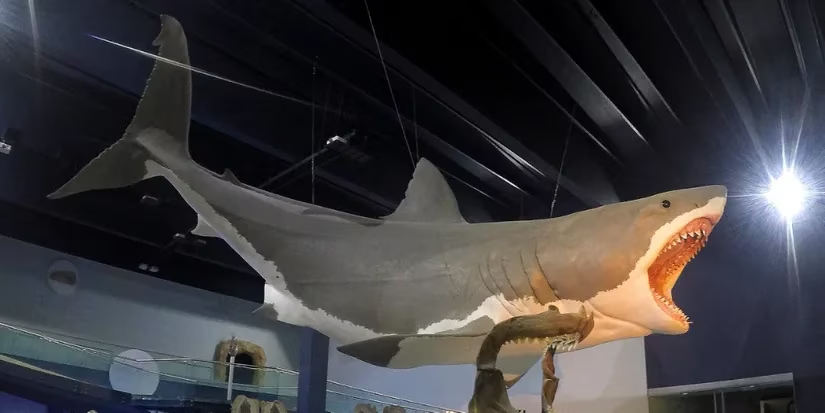
The evidence of its diet is etched in bone—not its own, but its victims'. Fossilized whales from the era bear horrific, fatal gashes that match the unique signature of Megalodon teeth. This paints a picture of an apex predator capable of taking down the largest creatures of its day. But a fascinating twist emerges from the fossil record. Contrary to popular monster-movie imagery, Megalodon likely often targeted prey smaller than itself. It was probably more of an opportunistic hunter than a dedicated giant-slayer. Think about it: the juveniles had to start somewhere, chasing fish and smaller sharks, relying on speed before they grew into their world-crushing power. They were efficient, not just enormous.
🚢 A Clash of Titans: Reality vs. The Game
This leads to a deliciously ironic thought. In Sea of Thieves, a Megalodon can sink a Galleon. But in the realistic seas of the Neogene? A wooden vessel of that size might have been... inconvenient, but not a meal. An adult Megalodon would likely think twice about attacking a Brigantine or Galleon. The ship's sheer mass, wooden hull, and metal reinforcements would mean the shark risked injuring itself more than the boat in a ramming attack. And that famous bite? The broad, flat underside of a large ship's hull would be a terrible fit for even a Megalodon's jaws—like trying to bite a wide, floating table. Its greatest weapon, nullified by simple geometry. The real terror for ancient sailors would have been the smaller, more maneuverable sharks, not the legendary giant. Funny how stories grow in the telling, isn't it?
So, when the music swells and the fin cuts the water in Sea of Thieves, a pirate faces more than a game mechanic. They face the legend of a real-world ghost, a predator whose true story is still being pieced together from the deep, one tooth at a time. They face the echo of the Neogene, a reminder that the sea's deepest shadows are often cast by creatures long gone, whose myths have grown larger than life itself.
Comments